The Personal Diary Before the Printed Journal
The personal diary before the printed journal took several forms. Learn how historical context can help you choose a record, reflective entry or prompt.
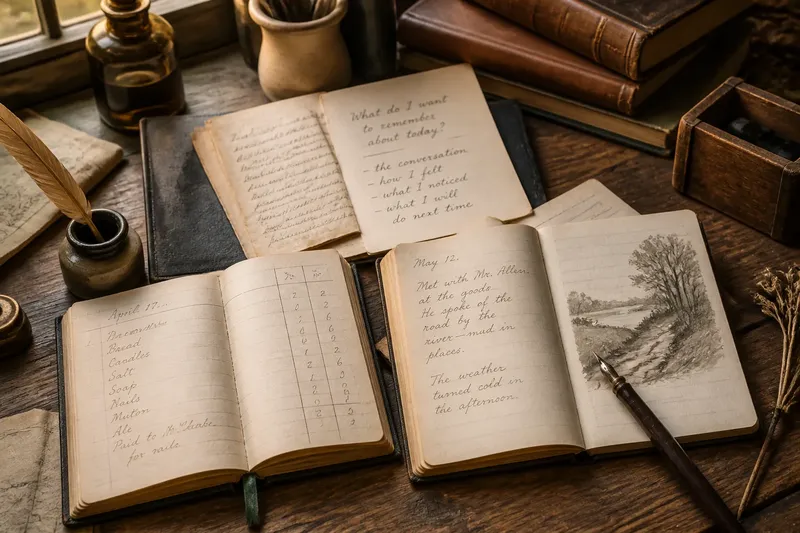
A notebook beside a household account book might hold a journey, a visitor’s name or a note about the weather. The personal diary before the printed journal was not a single genre: in early modern Europe, private writing could be practical record-keeping, spiritual examination or a mixture of both. That distinction can still help you choose what to put on a page today.
Surviving manuscripts are varied, so there is no simple history in which factual records gradually turned into inward reflection. The kinds of writing overlapped, and their purpose depended on the writer, setting and intended reader. Rather than treating the past as one straight line, it is more useful to look at these different uses side by side.
Keeping practical records
In early modern Europe, people kept records for everyday use: household accounts, travel notes, calendars, lists of events and personal observations. Some entries were private; others were part of family or business records that might be consulted by relatives or colleagues. These documents did not all share the same format or audience.
A record might preserve the details its writer expected to need again. A traveller could note a route or encounter; someone overseeing a household could record a purchase, visitor or task. Such entries might include feelings, but they did not have to turn each event into a polished story or an account of the self.
If you want to keep this kind of record now, use a dated notebook or a notes app. Write down the event, a concrete detail and anything you may need to recall later. “The meeting ran late; I agreed to send the revised draft” is more useful for future recollection than “busy day”.
Practical notes can become a bare inventory. Add one sentence about why a detail matters if you want the record to make sense when you return to it. The entry can remain brief; it does not need to explain the whole day.
Examining conduct
In early modern Europe, some personal writing was shaped by religious practice, moral self-examination and the wish to account for one’s conduct. Such writing could ask what a person had done, felt or intended, and whether their actions matched their obligations. This inward attention did not replace practical record-keeping; the forms could sit alongside each other, even within one person’s writing.
Nor did private writing necessarily mean writing for no audience at all. A writer might imagine a future self, a spiritual adviser or another reader. That expectation could affect what was recorded and how events were explained. The evidence varies by manuscript and context, so it is safer to speak of overlapping purposes than a universal change from ledger to introspection.
For a present-day reflective entry, begin with an event, name your response and ask what you want to understand. You do not need to arrive at a lesson. “I felt uneasy after agreeing” is a valid stopping point if the reason is not yet clear.
Say you have agreed to help a colleague with a task and feel resentful afterwards. Start with the concrete input: you agreed during a rushed conversation, and you had already planned to leave work on time. Write the action you took, then note the response: you felt frustrated and avoided saying so. Ask what you would prefer next time; your resulting answer might be, “I need to check my plans before agreeing.” That is a useful observation, not a verdict on your character.
Print and imagined readers
Printed diaries and journals brought different choices about audience and presentation. A published diary is not simply a private notebook made public: its text may have been selected, edited or arranged for readers. The writer or editor controls what appears, while the reader encounters an account shaped for publication.
That difference matters when choosing a journal now. A dated planner makes it easy to record events; a prompt-led book directs attention towards its questions; blank pages leave the subject to you. None is inherently more honest. Each format makes certain kinds of entry easier, much as a drawer with dividers makes some objects easier to sort without deciding what you should keep.
If you use a digital diary, consider where the account is stored and who can access it. If you use a paper notebook, consider where you will keep it. Convenience and privacy are separate decisions, so choose a form that fits both your writing habit and your comfort with disclosure.
Which diary fits?
What is the difference between a diary and a journal?
A diary often records dated events and observations, while a journal can be more open-ended or reflective. In ordinary use the terms overlap, so choose the word and format that make sense to you.
Do I need to write every day?
No. Write regularly if a routine helps, or make an entry when an event or question seems worth keeping. A forced account of an uneventful day is not required.
Are prompts better than blank pages?
Prompts can make it easier to begin and give an entry a clear subject. Blank pages suit writers who prefer to choose their own focus or find repeated questions restrictive.
Who should I imagine reading my diary?
You might write for future recollection, present reflection or possible sharing. Decide which purpose applies to a particular notebook, and avoid recording anything you would not be comfortable having read if privacy is uncertain.
Choose by purpose
Match the page to the task. Use a dated record to remember events, a reflective entry to examine a response or choice, and prompts when you want a ready-made starting point. A single notebook can hold all three; separate sections can help if you want to find each kind of entry later.
Imagine you have a plain notebook, a phone notes app and one recurring question: “What do I want to remember about today?” Your starting inputs are the event, the format and the purpose. First, record a specific event in the notebook; the result is a dated account you can revisit. Next, try the question in the notes app after a difficult conversation; the result is a focused reflection, though it may feel less private if the device is shared. Finally, compare the entries: if you mainly want to retrieve facts, keep the notebook as a record; if understanding your response matters more, use the prompt; if neither feels useful, change the format rather than forcing the habit.
The personal diary before the printed journal offers no single model to copy. It shows that the purpose of a page can vary with its writer and audience. Before your next entry, decide whether you want to preserve an event, examine a response or leave a thought somewhere safe to return to; that choice gives the page a clear job.